Yesterday was another transit day so let’s fast-forward through a train ride from Munich to Nuremberg/Nürnberg (but definitely not Nurburg) the second biggest city in Bavaria and the capital of Franconia! The city’s imperial castle was first mentioned in documentation dated 1050 when the city was of significant importance and strength in the Holy Roman Empire. Located in the geographical centre of two dissecting trade routes the city was the empires largest transport and logistics hub. During the late Middle Ages, the city was also known for arts, astronomy, science, innovation and publishing. The crafts of the Nuremberg goldsmiths were so heavily coveted that once you learn the trade you cannot leave the city effectively keeping the trade secrets contained within the five square miles of the old city walls. The Middle Ages were the golden era of Nuremberg and the city has worked hard to preserve that heritage.
Especially so as Er, Der Nicht Genannt Werden Darf was partial to Richard Wagner’s Die Meistersinger von Nürnberg, and the medieval city spoke to his thwarted dreams of becoming an architect, Nuremberg, already a central location, drew the National Socialists to the city for outrageous propaganda rallies. As such it had the ever-loving shit bombed out of it by the Allied Forces during World War 2 and most of what we enjoy today of the old city is in fact a very good restoration job.
After the war, the city again became a symbolic place for the International Military Tribunal and the trial of the 22 most significant and surviving leaders of the National Socialist Party. The Nuremberg Trials, was effectively the beginning of modern international criminal law and established The Nuremberg Charter. The Charter was negotiated by the United Kingdom, France, the United States and the Soviet Union at the London Conference from 26 June to 2 August and signed on 8 August 1945. Article 6 of the Charter defined the crimes being tried as: Crimes Against Peace, War Crimes, Crimes Against Humanity and Crimes of Aggression, all include conspiracy (to commit any of the above). It was the first time an individual actor would be held responsible for these acts, and not a sovereign state. Most famously perhaps is Article 8 which ensured the plea of acting under superior orders was not a valid defence. Interestingly, there was also a concerted effort to dismiss a tu quoque defence, which in essence relies on demonstrating that persons trying you are guilty of committing the same offence, i.e. well you did it too! (This has never been accepted in international criminal law probably because in war no one comes out with clean hands).
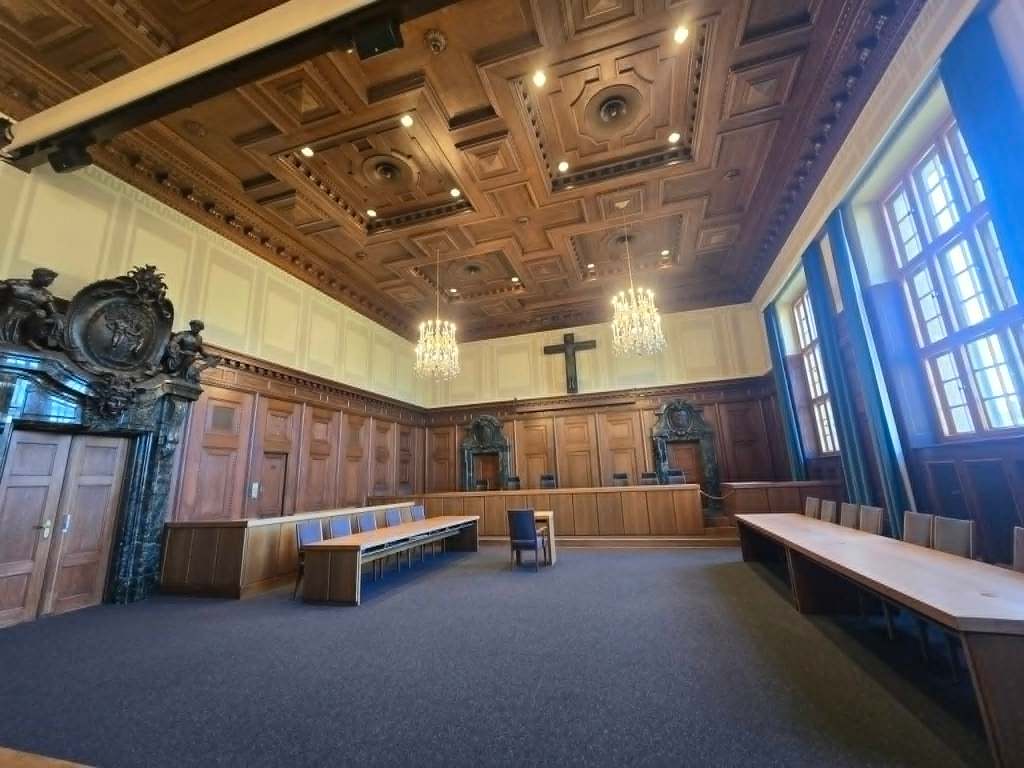
The trials themselves are immensely complicated, jurisprudentially fascinating and in the respect of four distinctly separate super-power coming together to, if nothing else, symbolically agree that war crimes = bad, kind of impressive. For me though, Courtroom 600, while the birthplace of the international criminal court is like a candle that’s flickered out. Reading the exhibits made me feel like, if the global community wanted to it could, but obviously the appetite to hold leaders accountable for the continuous and atrocious acts of the present day was short lived. There are 73 individual public indictments and 17 situations (conflicts, genocides, etc.) under investigation by the International Criminal Court as of today. I seriously doubt there will be anywhere near the condemnation or consequences of the Nuremberg trials for these.
And people wonder why I don’t practice law – ANYWAYS.
Death Eaters aside, Nuremberg is also home to three things I did immensely enjoy today – red beer, Lebkuchen (gingerbread) and sausages. Definitive proof the golden age of Nuremberg was the Middle Ages, and because I can’t help myself – you should know that in 2003 the Nürnberger Rostbratwurst (pork sausage) was granted Product of Protected Geographical Indication (PGI) status under EU law which means a product baring this name or description must be made within the geographic limits of the city, and must be made with the traditional recipe. The traditional recipe, no joke, was codified in 1313 by the City Council of the Free Imperial City of Nürnberg. This is a serious matter enforced by the Schutzverband Nürnberger Bratwürste e.V. with a notable case in 2024 where the Munich Regional Court safeguarded both name and origin but did concede that Rostbratwurst was generic enough to apply to sausage but this is only sparkling sausage unless it comes from Nürnberg.


Leave a Reply