Another spectacular day in Bavaria, which by design I think is what most people associate with Germany – the lederhosen, Oktoberfest, sausages (aren’t they just the wurst), shuttered farmhouses and fairytale castles. All originate in this state, once its own kingdom. Germany, as we know it today is a rather young country. The monarchy of Bavaria too though was quite short – 1806 to 1918. The shifting borders of Europe I am finding have a lot to do with Napoleon – the Netherlands, Belgium, Germany are all stamped with his influence. But today is not Napoleon’s limelight but Ludwig the second of Bavaria, der Märchenkönig, or Fairytale King. Also known as the Swan King and the Mad King.
Ludwig was a man with creative vision, a love of fairytales and a hard-on for the operas of his friend Richard Wagner. Even if opera means nothing to you, you will of course know the Wedding March or maybe the Flight of the Valkyries. Ludwig was ill suited as a ruler – shy, introverted and gay. The latter only really a problem when it comes to the task of making heirs, which he ardently avoided, despite once entertaining the idea of a lavender marriage to Duchess Sophie Charlotte before calling of the engagement. As I asked, I shall let you know that no, he wasn’t a lover of Wagner in the biblical sense. Wagner was much too old.
My interest in Ludwig has only come about through Neuschwanstein Castle. Entry to visit the castle is rigorously controlled, and to get in I had to book on a tour as all the walk-in spots were sold out. This meant leaving the Porsche parked up in Munich while I sat on a coach out to Schwangau. On the drive out our guide shared the history of Bavaria, the stories of George the Dragonslayer and Deutche Heldensagen. He told us of the Catholic influence in the area and the censorship of fairytales as viewed as competition with the Bible, and how the brothers Grimm had collected the old stories of Snow White, Hansel and Gretel, Sleeping Beauty and Cinderella.
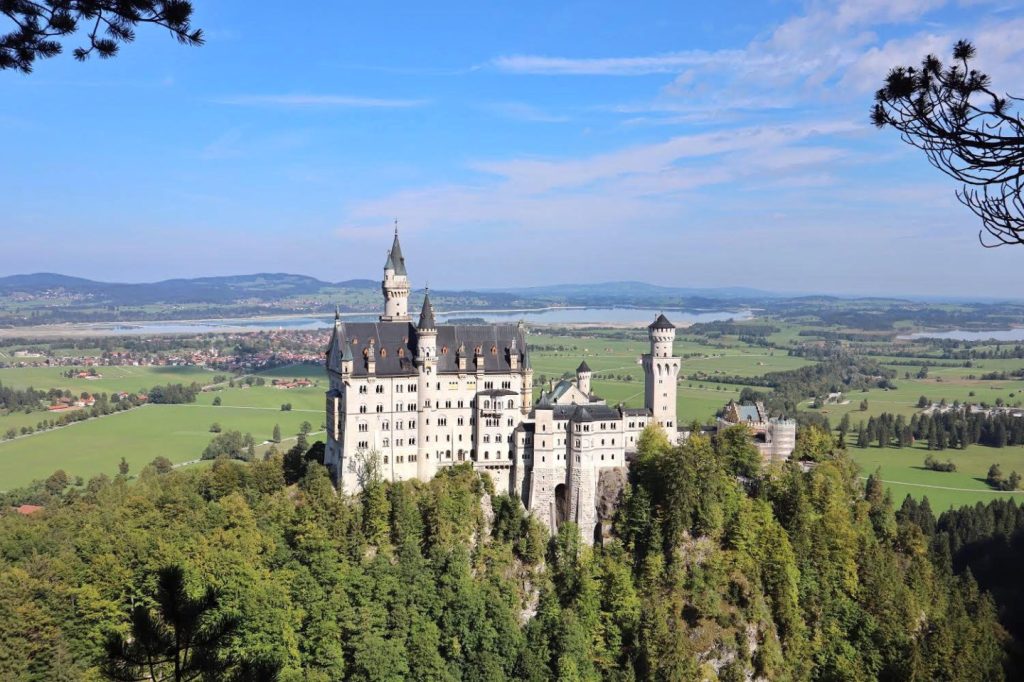
Neuschwanstein was designed by Ludwig to capture the beauty and the essence of the fairytales, sagas and musical dramas he loved. Only fourteen rooms within the castle were completed as Ludwig was in debt and out of favour with the government who commissioned four psychiatrists to certify him insane. With support of the doctors who collected rumour and hearsay evidence he was arrested in the bedchamber of Neuschwanstein and placed into custody at Berg Castle, dying under suspicious circumstances a few days later. His body, and that of one of the four psychiatrists who’d conspired with the government were found dead in Lake Starnberg.
Neuschwanstein is built on the remains of two medieval castles, Vorderhohenschwangau Castle and Hinterhohenschwangau Castle, its designs drawn up by a theatre set-designer, Christian Jank, and then realised by artchetect Eduard Riedel. The castle is built in a neo-Romanesque style but with Ludwig overseeing every draft, design and decision on its construction and decoration the actual result is quite interesting. The throne room for example has Jesus and his apostles, portraits of the six canonised kings, and directly opposite the throne a mural of George the Dragonslayer and the mosaic on the floor depicts the Buddhist wheel of life. Inspiration was drawn from Wartburg for the Hall of Singers, a kind of copy paste of both the Wartburg ballroom and its own hall of singers, including a gallery that is essentially a carbon copy. Each room was decorated with medieval sagas as told through the lens of Wagner’s operas; the grail legend, Tannhäuser, and Lohengrin. There’s even a grotto inside, and yes, I do mean a literal cave constructed to join the king’s living suite with a conservatory.
Neuschwanstein has only 14 rooms and adjoining hallways completed, approximately one third of the planned interior. The project abruptly halted with the King’s death. Six weeks later it was opened to the public as a means to recoup the debt. The castle, once intended to be a private retreat for a reclusive king now hosts 1.5 million visitors a year. Amongst those visitors were Walt Disney, J. R. R. Tolkien and C.S. Lewis all of them drawing inspiration from the castle and the fairytales enshrined on its walls.
Leaving the castle to return to Munich I think I’d like to learn more of der Märchenkönig. Far from the mad king, his life and leanings depict him more as a sad king.


Leave a Reply